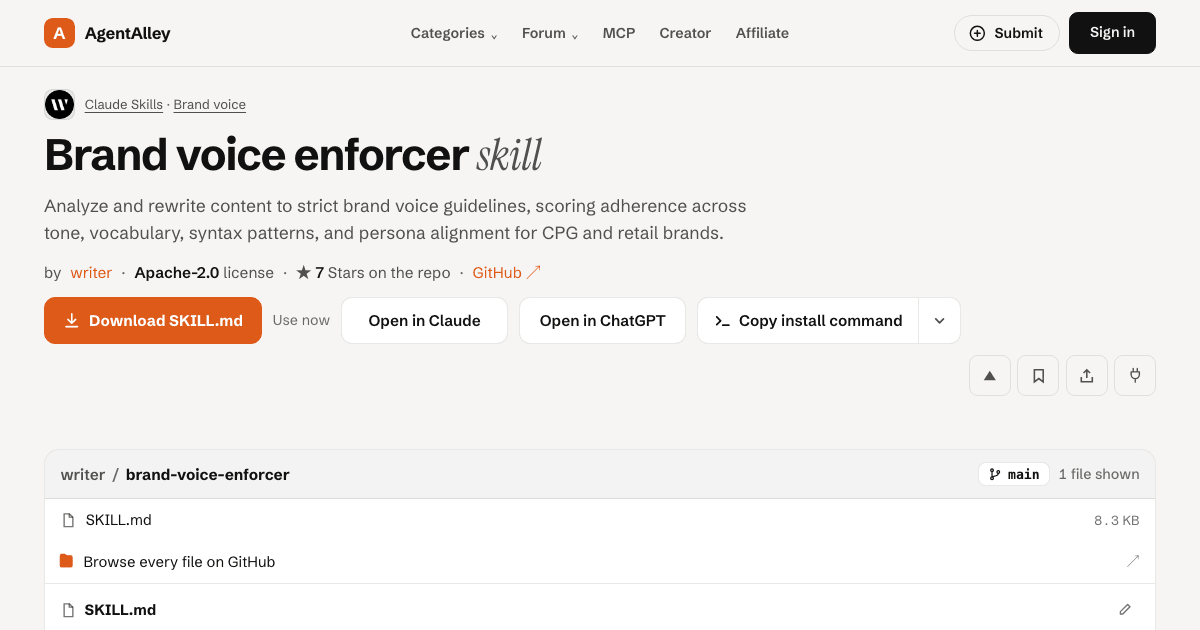
An AI brand voice is the set of written rules that makes AI-assisted copy sound like your brand and nobody else. Without those rules, every model falls back on the same habits: em dashes, generic phrases like "unlock the power of", and emoji that do not match your tone. Readers have learned to spot those tells. The fix is a short checklist that every draft passes before it goes live, whether a person or a model wrote it.
This guide takes the questions marketers keep asking on Reddit and answers them one by one, then gives you the full checklist.
How do people know a post was written by AI?
They recognise a pattern, not a single word. The three tells named most often are heavy em dash use, generic phrasing that could belong to any company, and emoji that clash with the brand's usual tone. One of these on its own is fine. All three together read as "nobody checked this".
A social media marketer on r/marketing described exactly this problem with a manager who rewrites approved posts:
"she heavily uses ai to rewrite or generate posts, and it's really obvious (overuse of em dashes, generic phrasing, weird emoji use that doesn't match our tone)"
Source: u/skankocean on r/marketing
Notice that none of these tells is about facts. The copy can be accurate and still feel off, because voice lives in punctuation, word choice and rhythm. That is good news: those are exactly the things a checklist can catch.
Use it now: run your last five posts through the checklist below and count how many tells each one has.
Does AI-written copy actually hurt a brand?
It can, when it replaces taste instead of supporting it. Audiences do not punish a brand for using AI. They punish copy that feels cheap or interchangeable, and unchecked AI copy often is.
An agency owner on r/marketing put it bluntly after a client replaced them with AI:
"AI is a great tool for brainstorming or fixing a workflow, but the second you use it to entirely replace human taste and strategy, your brand immediately looks like a cheap dropshipping scam."
Source: u/ScaryAd2555 on r/marketing
Another marketer admitted they now skip content as soon as it looks generated:
"Being a marketer myself, I'm skipping most of the ads, posts just seeing that Ai generated material, it's kind of putting me off.."
Source: u/Ok-Parking8122 on r/marketing
The lesson is not "never use AI". It is "never ship AI copy that nobody has checked against your voice". Mailchimp's public voice and tone guide is a good model here: it separates a fixed voice from a tone that changes with the situation, and it is written as plain rules that any writer, human or model, can follow.
How do I keep brand voice consistent when the team uses AI?
Write the voice down as rules and examples, give the same document to every person and every model, and check every draft against it before publishing. Consistency comes from one shared source of truth, not from each person's prompt.
A founder on r/personalbranding described the same struggle at the personal level:
"The voice problem is real. A perfectly polished AI can still sound like nobody."
Source: u/corwinsword on r/personalbranding
"Sounds like nobody" is the default output of a model with no constraints. Your job is to add the constraints. A voice document that works with AI has four parts:
- Rules a machine can check: punctuation, banned phrases, emoji, sentence length.
- Rules a human must judge: humour level, how direct you are, what you never joke about.
- Three good examples: real posts that sound exactly right.
- Three bad examples: real drafts that missed, with a one-line note on why.
The first part is where AI tools help most, because a skill can enforce it on every draft automatically.
Use it now: Brand Voice Enforcer on AgentAlley
What should an AI brand voice checklist include?
Seven checks cover almost every complaint in the threads above. Run them in order; the first five can be automated, the last two need a person.
- Punctuation rules. Decide whether you use em dashes at all. Most brands that complain about AI copy do not. Write "no em dashes, use a comma or a period" into the instructions, then search the draft for the character anyway. Do the same for exclamation marks and ellipses.
- Banned phrase list. Collect 20 to 50 phrases you never want to see: "in today's fast-paced world", "unlock the power of", "elevate", "seamless", "game-changer", "let's dive in". Add to it every time an editor catches a new one.
- Emoji policy. Name which emoji you use, where (only at the end, only on Instagram, never in email subject lines) and how many per post. If the answer is "none", say so. Models add emoji to look friendly, and the result is the "weird emoji use" the Reddit post complained about.
- Sentence length and reading level. Give a target, such as "most sentences under 20 words". AI drafts tend to stack long, balanced sentences with three-item lists. Short sentences sound more human and more like a person who knows what they think.
- Words we say vs words we never say. List your real vocabulary: product names, how you refer to customers, the slang you allow. This is the part that makes copy sound like you and not like any brand.
- Read-aloud test. One person reads the draft aloud. If it sounds like a press release when your brand sounds like a friend, it fails. This is the check that no tool replaces.
- Title test against real outliers. For headlines, hooks and video titles, compare your draft with titles that already overperformed in your niche, not with what the model thinks is catchy. More on this below.
Keep the list on one page. A voice guide nobody opens is worse than no guide, because it gives a false sense of control.
How do I test titles in my own voice instead of the AI's?
Start from titles that real audiences already rewarded, then rewrite them in your voice, then check them against your checklist. A model that writes titles from nothing produces safe, average ones. A model that rewrites proven titles under your rules produces titles that are both on-voice and likely to work.
The proof that a title works is an outlier: a video or post that got far more views than its own channel usually gets. We explain the score in Outlier score là gì? and show how to find them in How to Find Outlier Videos in Your Niche. The workflow for titles is:
- Pull 10 outlier titles from your niche, ideally from channels near your size.
- Give them to the model together with your voice document.
- Ask for three rewrites per title that follow every machine-checkable rule.
- Run the read-aloud test on the best five and keep two.
Use it now: Generate on-voice titles from outliers in govrl
Does brand voice matter for AI search and SEO?
Yes, because AI answers quote sources that are clear, specific and consistent. Pages written in a distinct, confident voice with direct answers are easier for both Google and AI assistants to cite than generic copy that says what every competitor says.
A marketer on r/marketing noted how crowded and same-sounding the AI-visibility tool market already is:
"the category is about 18 months old and every vendor claims the same coverage in the same words."
Source: u/Malicious_wargang_18 on r/marketing
"The same coverage in the same words" is the brand voice problem at the scale of a whole category. If you sound like everyone, nobody has a reason to quote you. Google's own guidance on AI-generated content says it rewards helpful, original content however it is produced, which means voice and specificity matter more than the tool you used.
If you want to go further on AI search, these skills cover structure and citations:
- AI Search SEO Citation Strategies: how to structure pages so AI assistants quote them.
- Ultimate SEO + GEO: a combined checklist for classic search and generative engines.
- SEO GEO: a lighter skill for auditing one page at a time.
Use it now: pick your most important page and check that the first paragraph answers the main question in two sentences, in your voice.
What is the fastest way to start?
Spend one hour this week on three things: a one-page voice document, a banned phrase list, and a find-and-replace pass for em dashes before every publish. That alone removes the three tells readers notice first. Add the read-aloud test next, and the outlier-based title test once you publish video or short-form content.
The goal is not to hide that you use AI. It is to make sure that what you publish sounds like you, every time, whoever or whatever wrote the first draft.
Related reading
- How to Find Outlier Videos in Your Niche
- Outlier score là gì? (Vietnamese)
- Does AI Voiceover Hurt a YouTube Channel?
Sources
- Reddit threads quoted above, linked inline (r/marketing, r/personalbranding)
- Mailchimp Content Style Guide, Voice and Tone
- Google Search Central, Google Search's guidance about AI-generated content (2023)